
Certificate of Origin Apostille and Attestation
Chamber of Commerce, MEA apostille and embassy attestation for certificates of origin issued in India, so that your buyer’s customs and bank accept the shipment documents without delay.
Certificate of origin apostille: quick answer
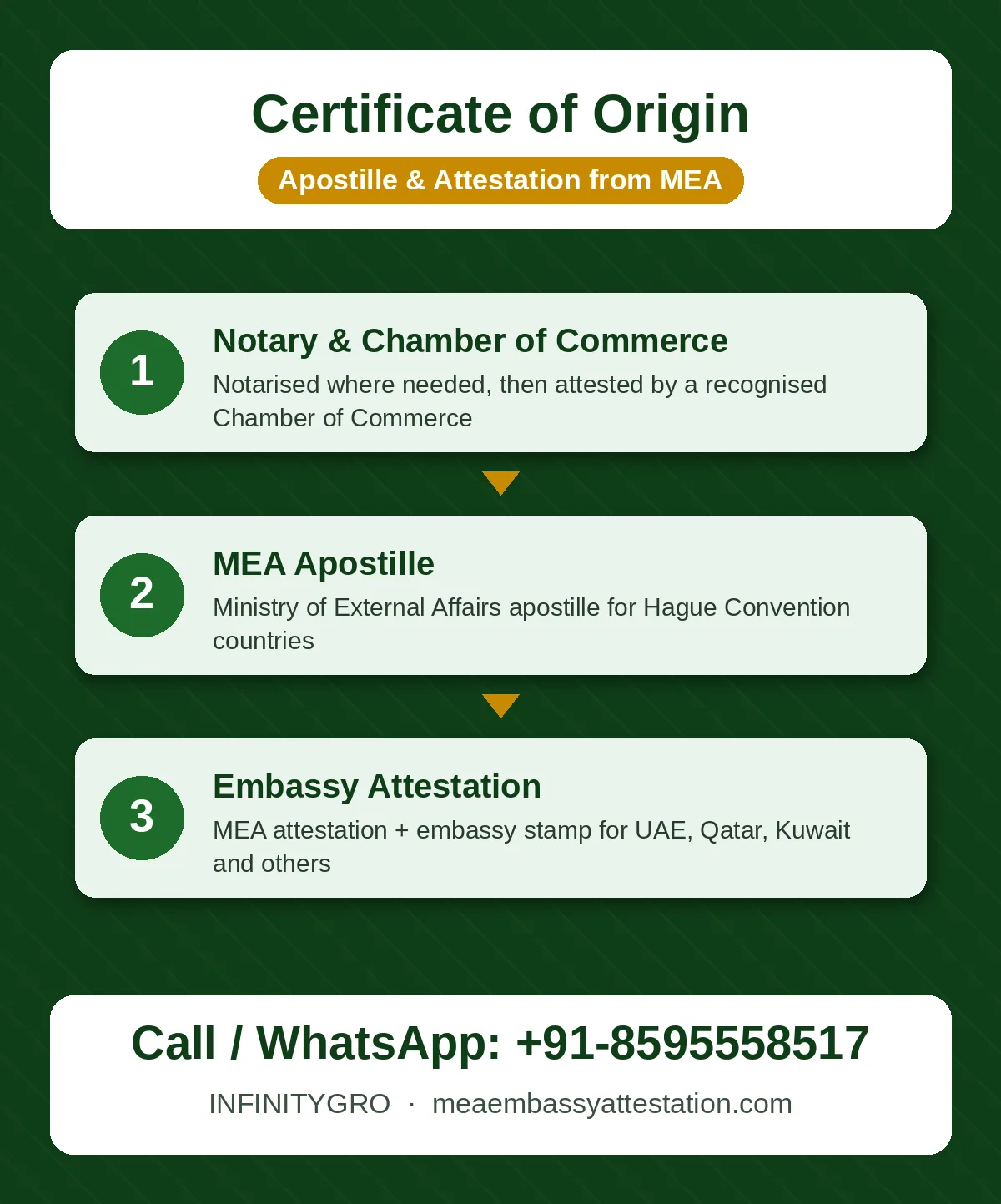
Certificate of origin apostille means getting your certificate of origin certified by the Ministry of External Affairs with an apostille sticker, so that Hague Convention countries accept it without any embassy stamp. The route is notarisation where needed, Chamber of Commerce attestation and then the MEA apostille; the MEA’s own fee is ₹50 per document.
Countries such as the UAE, Qatar, Kuwait and China are not covered by the apostille for Indian documents, so for them you need Certificate of origin attestation: MEA attestation after the Chamber of Commerce, followed by embassy legalisation.
INFINITYGRO handles Certificate of origin attestation in India for exporters, companies and individuals across India by courier. Send a WhatsApp photo of the certificate of origin and the destination country, and you get the route and a written quote before anything is sent.
Why a certificate of origin needs apostille or attestation
A certificate of origin (CoO) states where the goods in a shipment were made. Importers use it to clear customs and, under trade agreements, to claim lower duty. In India, non-preferential certificates are issued by chambers of commerce and export bodies, and preferential ones under trade agreements by the agencies the government has authorised, largely through the DGFT’s digital platform.
Some buyers, banks and customs offices abroad go a step further and ask for the CoO to be legalised. For Hague Convention countries that means an MEA apostille; for the UAE, Qatar, Kuwait, Egypt and other non-Hague countries it means MEA attestation followed by legalisation at that country’s embassy, usually together with the commercial invoice.
Customs clearance
Importing countries that check origin.
Letters of credit
Banks that ask for legalised shipping documents.
Preferential origin
Certificates issued under trade agreements.
Export document set
Usually legalised with the invoice and packing list.
Certificate of origin apostille: step-by-step process
Choose the route by the country where the certificate of origin will be used.
Apostille for Hague Convention countries
- 1Notary (where needed)Notarisation, if the certificate of origin needs it before the chamber.
- 2Chamber of CommerceA recognised Chamber of Commerce authenticates the document.
- 3MEA apostilleThe MEA fixes the apostille sticker (₹50 government fee per document).
Hague Convention countries
Full member list: HCCH Apostille Convention status table
Attestation for the UAE, Qatar, Kuwait and other non-Hague countries
- 1NotaryThe certificate of origin is notarised if needed.
- 2Chamber of CommerceThe chamber authenticates it.
- 3MEA attestationThe MEA attests the document.
- 4Embassy legalisationThe destination country’s embassy legalises it.
Non-Hague countries
Documents required for Certificate of origin attestation
- Original certificate of origin issued by the chamber or authorised agency (printed with its seal or digital verification code)
- Commercial invoice for the same shipment, if the buyer wants both legalised
- Company authorisation letter, signed and stamped
- Signatory’s passport or ID copy
- Where and why the document will be used
Certificate of origin apostille charges and time
| MEA apostille (government fee) | ₹50 per document |
|---|---|
| Chamber of Commerce | Chamber’s own fee; depends on the chamber and document |
| INFINITYGRO service | Quoted per document in writing |
| Embassy legalisation | Depends on the country; quoted in writing |
| Courier | Extra, both ways |
Each certificate of origin is a separate document for the chamber and the MEA. An export set of invoice, packing list and certificate of origin counts as three. More on our commercial document apostille page.
Tips before sending your certificate of origin
- Check that the exporter, consignee and invoice number on the CoO match the commercial invoice exactly; mismatches are the most common reason for rejection.
- Ask your buyer or bank in writing whether they need an apostille or embassy attestation before you start.
- Start legalisation as soon as the CoO is issued; embassy queues can be longer than the shipping time.
Official links for certificate of origin apostille and attestation
Rules change from time to time. These government and official pages are the primary sources we follow:
FAQs: Certificate of origin apostille and attestation
How do I get a certificate of origin apostilled by the Ministry of External Affairs?
The certificate of origin is notarised where required and then authenticated by a recognised Chamber of Commerce. After that the MEA checks the chamber’s attestation and fixes the apostille. Courier the original to us and we handle each stage.
What are the charges for Certificate of origin apostille?
For Certificate of origin apostille you pay the MEA fee of ₹50 per document, the chamber’s fee and our service charge; courier is extra. If you need embassy legalisation instead, we quote that embassy’s charges as well.
Who issues the certificate of origin in India?
Non-preferential certificates are issued by chambers of commerce and other authorised bodies, and preferential certificates under trade agreements by the agencies the government has authorised. Many are now issued through the DGFT’s common digital platform.
What documents are required for Certificate of origin attestation?
The original certificate of origin, signed and stamped by the company or issuing authority, an authorisation letter on company letterhead (we send the format) and an ID copy of the signatory. Tell us the destination country, because the route depends on it.
What is the process for Certificate of origin attestation for the UAE, Qatar or Kuwait?
Chamber of Commerce, MEA attestation and then the embassy: that is the route for the UAE, Qatar and Kuwait. The UAE also requires its own ministry stamp in the UAE.
Does an electronically issued certificate of origin need attestation?
If your buyer or the importing country asks for a legalised copy, yes. The printed certificate with its verification details goes through the chamber, the MEA and, where needed, the embassy.
How long does Certificate of origin apostille take?
It depends on the Chamber of Commerce, the MEA and, for attestation, the embassy. We confirm an expected completion date in your written quote and update you on WhatsApp at every stage.
Apostille or attestation: which one does my certificate of origin need?
Look at the destination. A Hague Convention member (for example Saudi Arabia, Oman, Bahrain, Italy or Japan) accepts the apostille. The UAE, Qatar, Kuwait and China need attestation and the embassy stamp.
Can the certificate of origin and invoice be attested together?
Yes. They are separate documents with their own stamps, but we process them as one export set so they come back together.
Is INFINITYGRO genuine, and does someone from the company need to visit Delhi for the certificate of origin?
INFINITYGRO is a document facilitation agency in New Ashok Nagar, Delhi, working with exporters and companies across India. We give a written quote, explain each stamp and return originals by tracked courier, with WhatsApp updates at every stage. Nobody needs to visit; we do not offer pickup, so the certificate of origin is couriered to our office or dropped off. Call or WhatsApp +91-8595558517.
Send your certificate of origin for apostille or attestation
WhatsApp a photo of the certificate of origin and tell us the destination country. You get the route, the documents list and a written quote before you courier anything.
Office: C – 5 A/2 New Ashok Nagar, Delhi – 110096 · Monday to Saturday, 10:00 AM to 7:00 PM
Apostille for other commercial documents
Disclaimer: INFINITYGRO is a private document facilitation service, not a government authority. Apostilles are issued only by the Ministry of External Affairs, Government of India, and embassy legalisation is done by the respective embassies. Procedures and fees change from time to time; please confirm current rules with the receiving authority.