
Vietnam Embassy Attestation for Export Documents: A Guide for Indian Exporters
Shipping to a buyer in Vietnam who wants your invoice or certificate of origin legalised? Those papers were left out of the apostille change of 11 September 2026, so they still go through the Chamber of Commerce, MEA attestation and the Vietnam Embassy in New Delhi. Here is how exporters should plan the paperwork, which papers are affected and how we handle them.
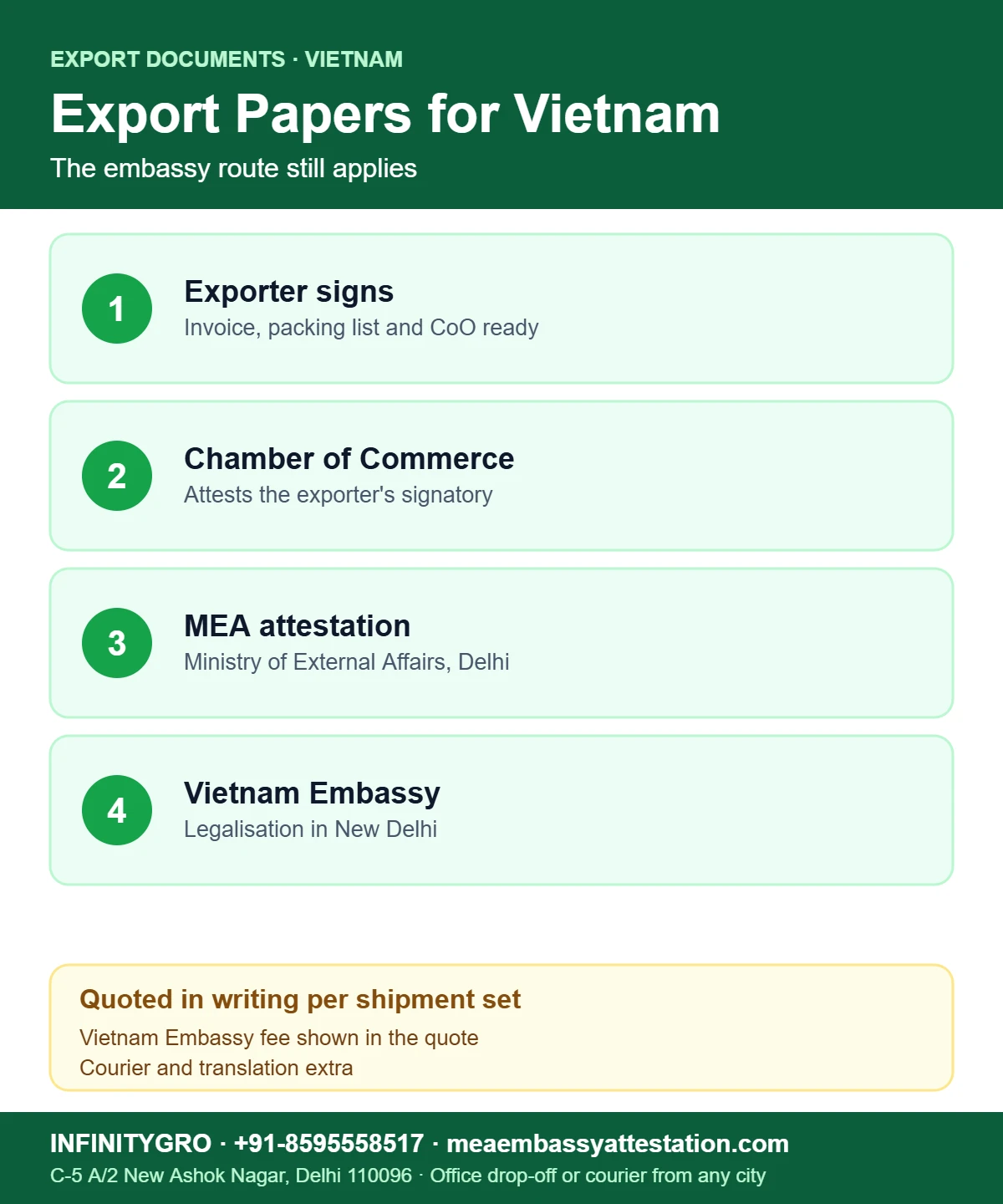
Export papers for Vietnam: quick answer
Vietnam embassy attestation for export documents is still needed even though Vietnam has joined the Apostille Convention. The Convention, in force for Vietnam since 11 September 2026, does not apply to administrative documents dealing directly with commercial or customs operations. The Embassy of Vietnam in New Delhi has said it will keep legalising Indian documents of that kind, so a commercial invoice or certificate of origin cannot simply be apostilled.
The route is Chamber of Commerce attestation of the exporter’s signatory, then MEA attestation, then Vietnam Embassy legalisation. INFINITYGRO takes the papers through all three in Delhi and quotes each set in writing after seeing it, with the embassy fee shown separately. Company papers such as a board resolution may take the apostille instead.
Why export papers still go to the Vietnam Embassy
Article 1 of the Apostille Convention leaves out two classes of document: those executed by diplomatic or consular agents, and administrative documents dealing directly with commercial or customs operations. Shipment papers fall in the second class.
The Vietnam Embassy’s notice reflects this. It stopped legalising Indian public documents within the Convention from 11 September 2026, but said it would continue to legalise documents outside it, naming administrative documents directly related to commercial or customs activities. Whether a paper is inside the Convention is decided by the law of the country where it was executed, which for your papers is India.
Export papers a Vietnamese buyer may ask you to legalise
Usually the embassy route
- Commercial invoice
- Packing list
- Certificate of origin
- Bill of lading or airway bill copy
- Shipping bill
Ask us first
- Certificate of analysis
- Free sale certificate
- GMP certificate
- Halal certificate
- Product registration papers
These are not always treated as customs papers. The MEA decides whether each one can be apostilled.
Vietnam embassy attestation for export documents, step by step
- 1Scans firstWhatsApp scans of the set and the buyer’s or bank’s request. We confirm the route for each paper and quote in writing.
- 2Originals to DelhiCourier the signed originals to our New Ashok Nagar office, or drop them off in Delhi. There is no home pickup.
- 3Chamber of CommerceA chamber attests the signature of your authorised signatory. The MEA requires commercial papers to be pre-authenticated this way.
- 4MEA attestationThe Ministry of External Affairs attests the chamber’s signature. This is attestation, not an apostille.
- 5Vietnam EmbassyThe embassy in New Delhi legalises the papers for use in Vietnam.
- 6ReturnWe courier the set back by Blue Dart or another secure courier, or you collect it.
Each stage depends on the queue at that office, so we give a time estimate with the quote rather than a fixed number of days.
Planning the paperwork around a shipment
Ask why it is needed
Legalisation is often a buyer’s, bank’s or tender’s requirement. Get the request in writing so you legalise only what is asked for.
Match every paper
Invoice number, consignee, quantities and values must agree across the invoice, packing list and certificate of origin. A mismatch stops the set at the chamber.
Plan for originals
Signed originals must physically reach Delhi. Build the courier days and the embassy stage into your shipping and payment dates.
Vietnamese translation and company papers
The embassy’s notice says documents used in Vietnam that are not in Vietnamese need a Vietnamese translation, notarised or certified under Vietnamese law. Many importers arrange this in Vietnam. If your buyer wants it from India, INFINITYGRO can translate into Vietnamese, quoted by page.
Company papers such as a certificate of incorporation, board resolution or company power of attorney follow the same embassy route: chamber stamp, MEA attestation and Vietnam Embassy legalisation. Our main page on commercial documents for Vietnam explains each step.
Vietnam embassy attestation for export documents: fees and time
| Commercial document | Chamber of Commerce + MEA (+ embassy where needed), quoted in writing after we see the document |
|---|---|
| Embassy legalisation fee | Extra where the country needs it; confirmed in your written quote |
| Courier | Extra, both ways |
| Translation | Quoted by language and page |
We quote each shipment set in writing after seeing the papers. The Vietnam Embassy fee and a time estimate are shown in that quote.
All charges for this country, including any embassy fee, are on its own fee page.
Vietnam embassy attestation feesFAQs: Vietnam Embassy Attestation for Export Documents: A Guide for Indian Exporters
Can I apostille a certificate of origin for Vietnam now?
Generally no. The Apostille Convention excludes administrative documents dealing directly with commercial or customs operations, and the Vietnam Embassy in New Delhi continues to legalise those. A certificate of origin therefore still goes through the Chamber of Commerce, MEA attestation and the Vietnam Embassy.
Why does the chamber stamp come first?
The MEA’s guidelines say commercial documents are to be pre-authenticated by a Chamber of Commerce. The chamber attests your signatory, the MEA then attests the chamber’s signature, and the embassy legalises the MEA attestation. Skipping the chamber is not possible.
How much does it cost?
Export sets are quoted in writing after we see the papers, because the number of pages, the chamber and the embassy fee vary. The Vietnam Embassy fee is extra and shown in your quote. Courier and any translation are also extra.
How long does it take?
It depends on the chamber, MEA and embassy queues at the time, so we give an estimate with your quote. The papers must reach Delhi in original, so add courier time and plan it against your shipping and payment dates.
Do I need to send original invoices?
Yes. The chamber, the MEA and the embassy stamp the signed paper itself, so scans or emailed PDFs cannot be legalised. Send signed originals on your letterhead, with your seal, in the number of sets your buyer has asked for.
Are papers legalised before 11 September 2026 still valid?
Yes. The Vietnam Embassy’s notice says documents legalised through consular channels before that date remain valid in Vietnam. Shipment papers are usually tied to one consignment, though, so each new shipment needs its own papers.
My buyer says an apostille is enough. Who is right?
Ask the buyer to confirm with the Vietnamese office that will receive the paper. Under the embassy’s notice, commercial and customs papers stay on the embassy route. If that office confirms in writing that it accepts an apostille, share it and we tell you whether the MEA will apostille that paper.
Do I have to visit Delhi or the embassy?
No. Courier the signed originals to our New Ashok Nagar office, or drop them off in Delhi. We do not offer pickup. INFINITYGRO submits and collects at each stage and returns the set by Blue Dart or another secure courier.
Official sources
Start Vietnam embassy attestation for export documents
WhatsApp scans of your invoice, packing list or certificate of origin and the buyer’s request. We mark the route for each paper and send a written quote.
Office: C – 5 A/2 New Ashok Nagar, Delhi – 110096 · Monday to Saturday, 10:00 AM to 7:00 PM · office drop-off or courier, no home pickup
Related guides
Disclaimer: INFINITYGRO is a private document facilitation service, not a government office or embassy. Apostilles and attestations are issued only by the Ministry of External Affairs and the embassies concerned; we do not issue, correct or verify certificates. Rules and fees can change, so check the requirements of the authority that will receive your document.
Last reviewed: October 2026