
Commercial Document Legalization for China: Chinese Embassy Process
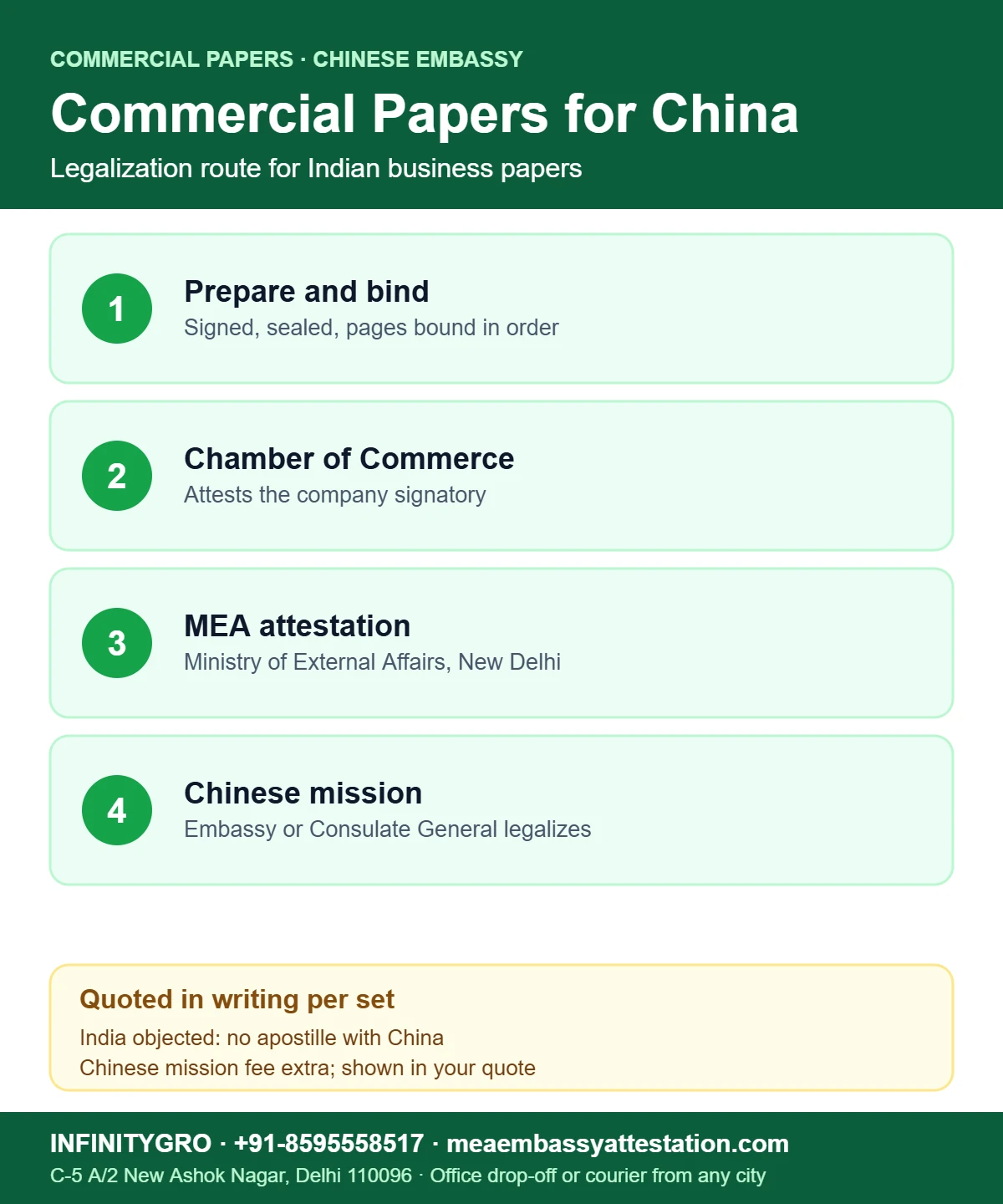
Company and trade papers from India still need embassy legalization for mainland China. China joined the Apostille Convention in 2023, but India objected, so no apostille applies between them. Each paper goes through a Chamber of Commerce and the MEA, then to the Chinese Embassy in New Delhi or a Consulate General. We prepare the set, run it and quote in writing.
Commercial papers for China in brief
Commercial document legalization for China is how an Indian company makes its business papers usable by Chinese authorities, banks and partners. It covers company papers such as certificates of incorporation, MOA and AOA, board resolutions and powers of attorney, and trade papers such as invoices, certificates of origin and product certificates.
The apostille is not available. China’s accession to the Apostille Convention took effect on 7 November 2023, but India objected to it on 8 September 2023, so the Convention does not run between the two countries. Indian commercial papers are attested by a Chamber of Commerce, then by the MEA, and then legalized by the Chinese Embassy in New Delhi or a Chinese Consulate General. INFINITYGRO handles each stage and quotes the set in writing; the Chinese mission’s fee is extra.
Why papers for China still need embassy legalization
Under Article 12 of the Convention, an existing member can object to a new member’s accession, and the Convention then does not apply between the two. India did exactly that for China. The result for Indian businesses is that the older legalization chain stays in place.
| Hague country, for example Germany or Japan | Chamber → MEA apostille |
|---|---|
| Mainland China | Chamber → MEA attestation → Chinese Embassy or Consulate General |
| Hong Kong or Macao | Separate rules; ask us before sending |
Indian documents for use in China must be attested by the MEA before the Chinese mission will legalize them, as the Chinese visa centre in New Delhi also explains on its authentication page.
Commercial papers the Chinese mission legalizes
Company papers
- Certificate of incorporation
- MOA and AOA (certified copies)
- Board resolutions and authority letters
- Powers of attorney for a Chinese agent or lawyer
- Company profile
- Agreements with Chinese partners
Trade and product papers
- Commercial invoices
- Certificates of origin
- Packing lists
- Free sale and GMP certificates
- ISO and quality certificates
- Product catalogues signed on letterhead
If the Chinese side asked only for a company profile, our company profile guide for China explains how to prepare it.
Commercial document legalization for China, stage by stage
- 1Share the checklist and scansWhatsApp the papers and the Chinese party’s list. We flag likely refusals and confirm the quote in writing.
- 2Send the originalsCourier them to our New Ashok Nagar office, or drop them off in Delhi.
- 3Notary, where neededSome papers, such as a POA, are notarised in India before the chamber stage. We tell you which.
- 4Chamber of CommerceA recognised chamber attests the company signature. The MEA requires this for commercial papers.
- 5MEA attestationThe MEA attests the chamber’s signature.
- 6Chinese Embassy or Consulate GeneralThe Chinese mission for the relevant area legalizes each paper, and we return the set by Blue Dart or another secure courier.
Why the Chinese mission sends papers back
The Chinese mission sets out the grounds on which it may refuse to legalize a paper. Most refusals we see trace back to one of these.
Seals and signatures
A seal or signature that is not genuine, not on record, or does not match the record can lead to refusal.
Binding and format
Multi-page papers must be bound so pages cannot be swapped, and seals and signatures must meet the technical standards of the issuing and receiving authorities.
Content
The mission may refuse papers whose content it considers harmful to China’s national or public interests. Avoid maps and political content in company material.
Planning a China file: order, translation and timing
- Get the full list from the Chinese side before you sign anything
- Make company names and addresses identical across every paper
- Sign the board resolution before the POA it authorises
- Ask whether Chinese translations are needed and where they should be certified
- Tell us your deadline, such as a trade fair or tender date
INFINITYGRO can translate papers into Chinese. For papers going to apostille countries instead, see our commercial document apostille page.
Commercial document legalization for China: fees and time
| Commercial document | Chamber of Commerce + MEA (+ embassy where needed), quoted in writing after we see the document |
|---|---|
| Embassy legalisation fee | Extra where the country needs it; confirmed in your written quote |
| Courier | Extra, both ways |
| Translation | Quoted by language and page |
Chamber and Chinese mission charges depend on the type and number of papers, so each set is quoted in writing with a time estimate.
Embassy fees for this country are listed on its own fee page.
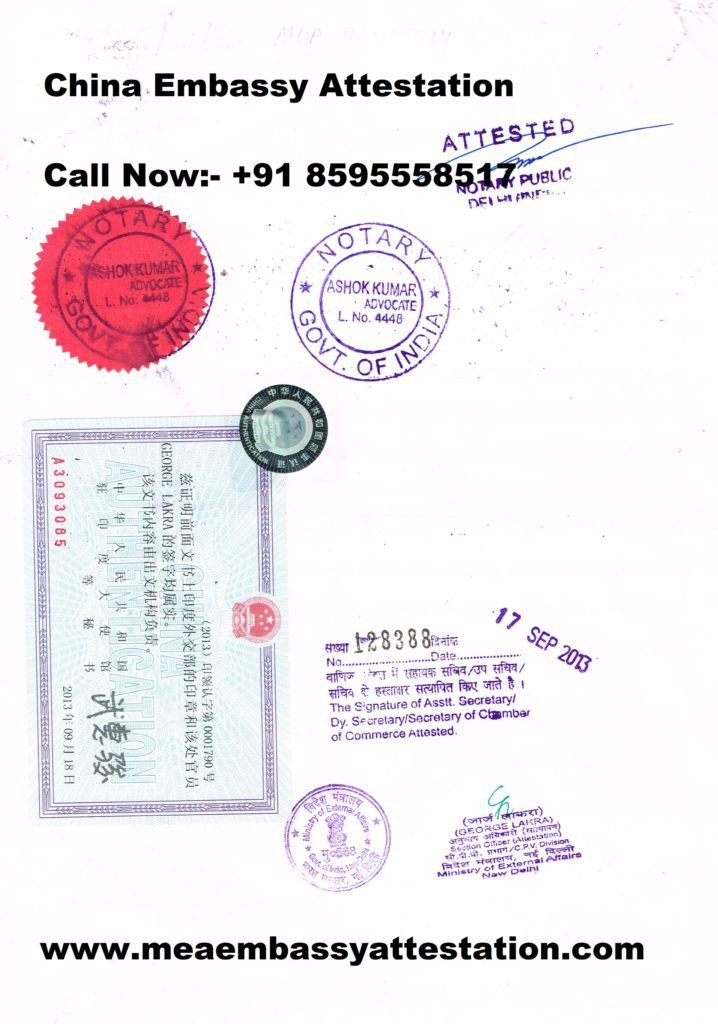
China embassy attestation feesCommercial Document Legalization for China: Chinese Embassy Process: real sample
A real document from our files, with personal details hidden. Check the stamps on your own document against it.
FAQs: Commercial Document Legalization for China: Chinese Embassy Process
China joined the Apostille Convention. Why do I still need the embassy?
Because India objected to China’s accession on 8 September 2023. Under the Convention, an objection means it does not apply between the two countries. Indian papers for mainland China therefore still need MEA attestation and legalization by the Chinese Embassy or a Consulate General.
Which commercial papers can be legalized for China?
Company papers such as the certificate of incorporation, MOA and AOA, board resolutions, powers of attorney and company profiles, and trade papers such as invoices, certificates of origin, packing lists, and free sale, GMP and ISO certificates. Share the Chinese checklist and we confirm each item.
Is a chamber stamp needed before the MEA?
Yes, for commercial papers. The MEA requires them to be pre-authenticated by a Chamber of Commerce. Without the chamber stamp the MEA will not attest the paper, and the Chinese mission will not legalize a paper the MEA has not attested.
Do all papers go to the Chinese Embassy in New Delhi?
Not always. China has Consulates General in India as well as its embassy in New Delhi, and papers go to the mission that covers the relevant area. We confirm which mission applies when we quote, and we handle the submission and collection for you.
What are the common reasons for refusal?
Seals or signatures that are not on record or do not match, multi-page papers that are not properly bound, and content the mission considers against China’s national or public interests. We check form and binding before submission to reduce the risk.
Can papers for Hong Kong go the same way?
Hong Kong and Macao follow separate rules from mainland China, so do not assume the same route. Tell us the exact city and the receiving office before sending anything, and we confirm the route and the quote for that destination in writing.
How long does legalization for China take?
It depends on the chamber, the MEA and the Chinese mission’s workload, and on how many papers are in the set. We give an estimate with your written quote rather than a fixed figure. Add courier time to Delhi and back.
Do Chinese partners need translations?
Often. Chinese offices work in Chinese, and many ask for translated papers. INFINITYGRO translates into Chinese. Ask your partner whether the translation must be legalized from India or certified in China, so the work is done in the right order.
Official sources
Start commercial document legalization for China
WhatsApp scans of the papers and the checklist from China. We flag likely refusals and send a written quote for the set.
Office: C – 5 A/2 New Ashok Nagar, Delhi – 110096 · Monday to Saturday, 10:00 AM to 7:00 PM · office drop-off or courier, no home pickup
Related guides
Disclaimer: INFINITYGRO is a private document facilitation service, not a government office or embassy. Apostilles and attestations are issued only by the Ministry of External Affairs and the embassies concerned; we do not issue, correct or verify certificates. Rules and fees can change, so check the requirements of the authority that will receive your document.
Last reviewed: October 2026