
Australia Embassy Attestation: Why the High Commission's Fee List Is Not Your Fee List
Australia embassy attestation is a phrase that sends thousands of Indians looking at the Australian High Commission's published fee schedule, finding a line that reads “preparing and issuing an apostille”, and concluding they must pay it. They must not. That charge is for Australian documents. An Indian degree, PCC or marriage certificate is apostilled by the Ministry of External Affairs in New Delhi, and the High Commission has no part in it.
Australia joined the Hague Apostille Convention with effect from 16 March 1995, so one MEA apostille completes an Indian document for Canberra, Sydney or Melbourne. The more useful question, and the one this page answers properly, is whether you need an apostille at all — because for most Australian visa purposes you do not.
- Australia has accepted apostilles since 16 March 1995
- The High Commission does not attest or apostille Indian documents
- Most visa applications need certified copies, not an apostille
- Quoted in writing before anything reaches a counter
What does an Indian document actually need for Australia?
Quick answer Last updated 8 October 2026
The Australian High Commission does not attest Indian documents, and Australia embassy attestation is not a stage in any Australian application. Australia has been a party to the Hague Apostille Convention since 16 March 1995, so an Indian public document is notarised, attested by a Sub-Divisional Magistrate in Delhi and then apostilled by the Ministry of External Affairs, Government of India. For most visa applications, however, the Department of Home Affairs asks only for certified copies, not an apostille at all.
- Hague Apostille Convention
- Australia is a contracting party (in force 16 March 1995)
- Correct route from India
- Notary → Sub-Divisional Magistrate → MEA apostille
- Does the High Commission attest Indian papers?
- No — it has no role in legalising Indian documents
- Does a visa application need an apostille?
- Usually no — certified copies are the norm
- When an apostille is genuinely needed
- Marriage registration, courts, property, powers of attorney, some professional registration
- The High Commission’s own apostille fee
- Applies to Australian documents only, not to Indian ones
- Translation
- Non-English documents need a NAATI-certified English translation
- Who issues the stamp
- Ministry of External Affairs, Government of India
- Handled by INFINITYGRO
- Notary, SDM and MEA stages, from our Delhi office
Apostille or Australia embassy attestation? What Australia expects
Australia does not attest Indian documents at a diplomatic counter. The Apostille Convention entered into force for Australia on 16 March 1995 and Australia raised no objection to India's accession, so a numbered MEA apostille from New Delhi is the complete legalisation of an Indian public document for Australian use.
Now the confusion this page exists to clear up. The Australian High Commission publishes a consular and notarial fee schedule, and one of the items on it is the preparation and issue of an apostille. People find that line, assume it applies to them, and either try to book an appointment or pay an agent to arrange something that does not exist. That item covers Australian documents being apostilled by an Australian official for use overseas. It has nothing to do with an Indian degree, an Indian police certificate or an Indian marriage certificate, all of which are apostilled by the Ministry of External Affairs in New Delhi.
One more naming point: Australia and India are both Commonwealth members, so the mission in New Delhi is a High Commission rather than an embassy. Searching for Australia embassy attestation is perfectly normal habit, but the office has a different name and in any case does not perform the service.
The 1995 entry-into-force date is published in the HCCH status table for Convention No. 12. What the Australian High Commission does and does not do is set out on its own consular pages, linked further down this page.
The route an Indian document takes for Australia
Three stages inside India, finishing in New Delhi, and often not needed at all. Work out first whether the Australian body receiving your document actually wants an apostille, because on this route more money is wasted on unnecessary legalisation than on any other destination we handle. Everything Australia embassy attestation involves is in those stages and nowhere else.
Notary and SDM in Delhi, then the MEA apostille
The chain ends at the Ministry. Nothing travels to the High Commission.
- Arranged by you
Ask the receiving body whether a certified copy will do
This single question saves most people the entire exercise. Visa applications are lodged online with certified copies; an apostille is not part of the standard Department of Home Affairs checklist. Only a court, a registry office or a specific regulator is likely to insist on one.
- Handled by INFINITYGRO
Notary Public and Sub-Divisional Magistrate attestation in Delhi
A Notary Public in Delhi enters and seals the document, then a Sub-Divisional Magistrate attests the notary's signature. This is the clearance the Ministry's apostille counter requires on a fast-track file, and we handle it end to end.
- Handled by INFINITYGRO
MEA apostille
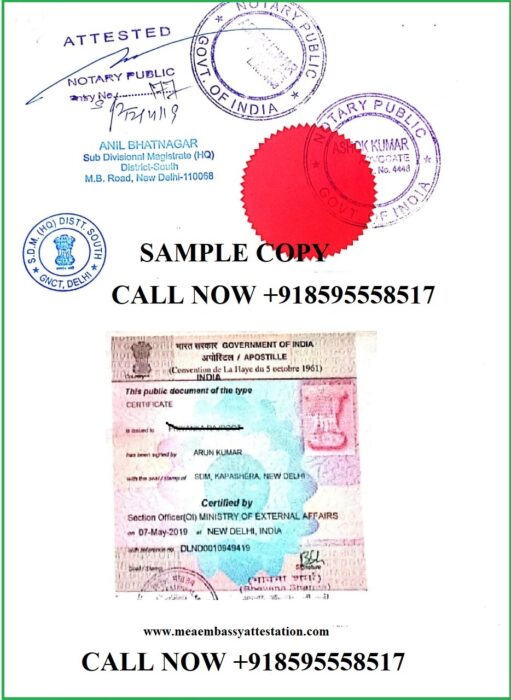
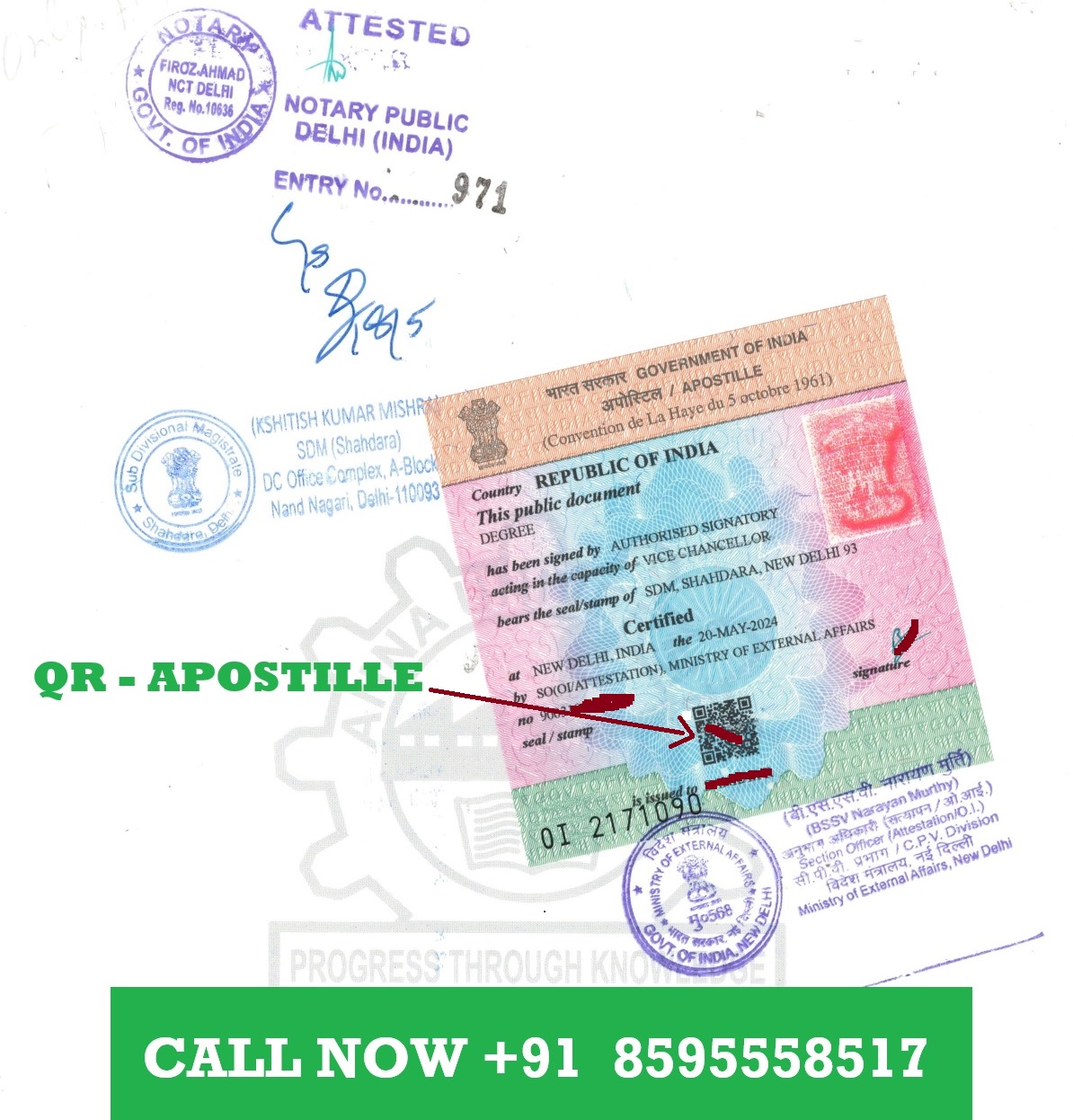
The Ministry of External Affairs affixes a numbered apostille sticker carrying a QR code to the reverse of the document. For Australia that completes the legalisation. A NAATI-certified translation, where the document is not in English, is commissioned afterwards.
Typically needed for: Registering a marriage in an Australian state, family and property matters, powers of attorney, court proceedings, estate and succession files, and a handful of professional registration bodies that ask for legalised originals.
Verify the Australia embassy attestation position yourself — it takes a minute
Australian bodies are good at publishing their requirements, so read the actual checklist rather than a forum post. Ask two things in writing: will a certified copy suffice, and if not, is an apostille required or merely a notarised copy. Those two answers decide whether you spend anything at all, and they matter far more than anything written about Australia embassy attestation.
Three families of document, and the path each takes
There is no single process. There are three, and which one applies to you depends entirely on what kind of paper you are holding. Personal certificates, academic records and trade documents each take their own path up to the Ministry of External Affairs, where the chains finally converge. Work out your category first and the rest of Australia embassy attestation becomes simple.
Personal and non-educational records
This group covers the records of a person's life rather than their qualifications. They are usually issued by a municipal body, a registrar or a police authority, and in Australia embassy attestation only the issuing authority's own certificate can enter the chain.
What is in this group
- Marriage certificate
- Birth certificate
- Police Clearance Certificate
- Single status certificate
- Divorce decree
- Affidavit
- Medical fitness certificate
- Death certificate
- Succession certificate
- Personal Power of Attorney
The route
- The notarial stage. A Delhi Notary inspects the original, makes the register entry and applies the seal. Everything above it in the chain rests on this one signature.Handled by INFINITYGRO
- Sub-Divisional Magistrate. The magistrate's office confirms the Notary's seal is genuine and adds its own. This is the route we use by default because it is faster and more predictable.Handled by INFINITYGRO
- Or the State route. Certain receiving offices require the Home Department or Regional Attestation Centre of the State that issued the certificate. It is slower than an SDM, it is done in that State, and arranging it is your side of the work.Arranged by you
- The MEA sticker. Applied in New Delhi once the Ministry has verified the stamp beneath it. Nothing reaches Australia without it, and since 2012 the Ministry has taken files only from registered agencies.Handled by INFINITYGRO
- Australia accepts the apostille, and the chain ends there. The Ministry applies a numbered sticker with a QR code to the reverse. Nothing afterwards goes to a Australia mission, which is why Australia embassy attestation is really apostille work.Final stage
Degrees, diplomas, marksheets and transcripts
Degrees, diplomas and the paperwork behind them. Of the three families this one carries the most risk of delay, because the long branch involves an institution and a State department that answer to nobody's deadline but their own.
What is in this group
- Degree certificate
- Transcripts
- Semester marksheets
- Diploma certificate
- 12th certificate
- 10th certificate
- Nursing registration certificate
- ITI / trade certificate
- Provisional degree
- Syllabus / course content sheet
- Bonafide certificate
- PhD certificate
The route
- Notary Public, in Delhi. A Notary enters the document in the register and applies a seal and signature. Nothing can move further up the chain without it.Handled by INFINITYGRO
- SDM attestation. A Sub-Divisional Magistrate verifies and attests the Notary's signature. It is the quicker of the two State-level options and is accepted by the Ministry for most destinations.Handled by INFINITYGRO
- The long branch: State HRD. Where asked for in writing, the Human Resource Development or Higher Education Department of the issuing State authenticates the document, normally after the university confirms its genuineness. It is the slowest part of any educational file and it is your side of the work.Arranged by you
- MEA authentication. The Ministry verifies the stamp below it and adds its numbered sticker. For Australia this is the stage everything else has been building towards. Individuals have not been able to lodge directly since 2012.Handled by INFINITYGRO
- Australia accepts the apostille, and the chain ends there. The Ministry applies a numbered sticker with a QR code to the reverse. Nothing afterwards goes to a Australia mission, which is why Australia embassy attestation is really apostille work.Final stage
Company, trade and export paperwork
The company chain. Fewer stages than the other two, but a different opening move: a recognised Chamber rather than a Notary. Commercial documents for Australia also normally need a signed covering letter on letterhead.
What is in this group
- Power of Attorney
- Board Resolution
- Memorandum of Association (MOA)
- Articles of Association (AOA)
- Certificate of Incorporation
- Partnership deed
- Trade licence
- Commercial invoice
- Certificate of Origin
- Packing list
- Distribution agreement
- Agency agreement
- Memorandum of Understanding
- Free Sale Certificate
- Price list
- Certificate of Analysis
- Export documents
- Shareholding pattern
- Letter of Authority
- Audited balance sheet
The route
- Chamber of Commerce attestation. A recognised Chamber of Commerce verifies the company and attests the document. This replaces the Notary and SDM stages entirely; commercial papers never go to a magistrate.Handled by INFINITYGRO
- MEA, New Delhi — the last Indian counter on a Australia file. The Ministry checks the stamp below against its specimen records and applies its sticker. Walk-in submission by individuals ended in 2012.Handled by INFINITYGRO
- Australia accepts the apostille, and the chain ends there. The Ministry applies a numbered sticker with a QR code to the reverse. Nothing afterwards goes to a Australia mission, which is why Australia embassy attestation is really apostille work.Final stage
Not sure which family your paperwork falls into? Send a photograph before you pay for anything. In Australia embassy attestation a document pushed down the wrong chain cannot be corrected at the next counter; it goes back to stage one, and the earlier fees are gone.
Taken one document at a time
Australian requirements are driven by what you are applying for, not by the document type, and for the largest single group of applicants the answer is that no legalisation is required at all. Australia embassy attestation is the search phrase; an apostille, where anything is needed, is the real requirement. One Australia embassy attestation chain, several very different reasons for needing it.
Degree certificate apostille for Australia
A degree certificate apostille for Australia is needed much less often than people expect. Skilled migration and student applications are assessed on certified copies and on assessments made by the relevant skills assessing authority, which deals with your university directly. An apostille comes in for certain professional registration bodies and for court or estate matters.
Registration and courtsDiploma, ITI and trade certificates
Polytechnic diplomas, ITI trade certificates and vocational qualifications follow the same apostille route where one is required. For trade occupations the skills assessment matters far more than any stamp, and those assessing bodies have their own document rules which an apostille does not satisfy.
Technical qualificationsBirth certificate apostille for Australia
A birth certificate apostille for Australia comes up in family and dependant matters, in registering a birth and in estate files. For a partner or child visa the Department ordinarily wants certified copies. Use the municipal registrar's certificate rather than a hospital record, and expect the name spelling to be checked against the passport.
Family and registry mattersMarriage certificate apostille for Australia
A marriage certificate apostille for Australia is the commonest genuine use of this route, because registering a foreign marriage with an Australian state registry, and some family court matters, do require legalised originals. Send the registrar's certificate rather than a ceremony record.
State registry and courtsPolice Clearance Certificate
An Indian Police Clearance Certificate is a standard part of Australian visa files, and it is normally uploaded as a scan or a certified copy rather than apostilled. Where a regulator or an employer asks for a legalised original, it is apostilled on the same chain. Obtain it close to your filing date because it is treated as recent-dated.
PCCCommercial and company documents
Invoices, certificates of origin, board resolutions, MOA and AOA and powers of attorney take a Chamber of Commerce stage before the Ministry. Australian company registration, property transactions and commercial disputes are the usual destinations, and powers of attorney for property in India are the single most common document on this list.
Chamber of Commerce firstWhat changes Australia embassy attestation fees
Australia embassy attestation fees, as a charge payable to the Australian mission for legalising an Indian document, do not exist. What an Australian file actually costs you is this.
1Very often, nothing at all
The largest saving on this route is discovering you never needed an apostille. If the Australian body accepts certified copies, and most do, there is no legalisation cost whatsoever.
2No High Commission charge on an Indian document
Even where an apostille is required, it is issued by the Ministry of External Affairs in New Delhi. Nothing is payable to the Australian mission, whatever its own fee schedule says about apostilles on Australian papers.
3The Ministry's statutory charge, and the stages before it
Where an apostille is genuinely needed you pay the Ministry's fixed charge per document, the Notary and SDM stages, our handling and the courier. That is the whole of it.
4NAATI-certified translation
Required where a document is not in English, arranged with a translator accredited in Australia, and priced by them rather than by us.
5Skills assessment and registration fees
Paid to the assessing authority or the regulator. These are often the largest numbers in an Australian move and they have nothing to do with attestation.
Our degree certificate apostille and attestation fees page sets out the whole charging structure stage by stage, and the diploma certificate fees page covers polytechnic and ITI qualifications. A WhatsApp message brings a written quote for your own file.
Australia embassy attestation: who genuinely needs an apostille, and who is wasting money
This is the most over-attested destination we deal with. Indians routinely pay for apostilles on full document sets for Australian applications that never asked for one. Find yourself in the list below before you spend anything.
Skilled migration and employer-sponsored visas. Lodged online. The Department of Home Affairs works from certified copies, and your qualifications are judged by a skills assessing authority that contacts your university or institute directly. An apostille on your personal copy does not feed into that assessment and does not speed it up.
Student visas. Also online, also certified copies. Universities ask for academic transcripts sent through their own channels. If an Australian university's page says documents must be “certified”, that means a certified copy, not a legalised one — two different things that the same English word covers.
Partner, parent and child visas. Certified copies again for the application itself. Where an apostille appears is afterwards: registering the marriage with a state registry, or a family court matter.
Marriage, courts, property and estates. This is where apostilles are genuinely required. Registering a foreign marriage in an Australian state, a power of attorney for property in India, probate and succession files, and contested family matters all want properly legalised originals, and the registries are strict about them.
Professional registration. A minority of Australian regulators ask for legalised qualifications. Most work from the skills assessment instead. Ask your regulator in writing rather than assuming, because this is the one group where the answer genuinely varies.
And the fee schedule trap. If you have landed here after reading the High Commission's charges and seeing an apostille listed at sixty dollars, you have found the single most misunderstood line in Australian consular paperwork. It is for Australian documents. Nothing on that schedule is Australia embassy attestation, and nothing on it will legalise your Indian degree.
In short, Australia embassy attestation is a search term rather than a service. Send us the checklist you were given, and the first thing you will be told is whether you need us at all.
Where our Australia embassy attestation work stops
Most disputes in this trade come from unstated limits, so here is exactly where our Australia embassy attestation work stops.
Arranged by you, not by us
- Institutional verification. We do not correspond with universities, boards or ITIs about your qualification.
- Authentication by the issuing State. Whether HRD or the home department, that stage is organised and paid for by you.
- NAATI translation, skills assessments and professional registration. Those are arranged with the assessing body or translator in Australia.
- Visa and permit charges. These go to the mission or online portal processing your application, never through us.
- Obtaining a fresh copy of a certificate. The issuing registrar, board or university does this, not us.
INFINITYGRO facilitates; it does not decide. Statutory stages cannot be skipped by anyone, and the outcome rests with the Ministry and the receiving authority.
What we need from you to start
Only start this once an Australian body has confirmed that an apostille, rather than a certified copy, is required. Australia embassy attestation will not be on their list, but an apostille sometimes is. This is the set that begins the work. Send them together rather than in instalments, and Australia embassy attestation begins at once.
- The written requirement from the Australian registry, court or regulator — the item that decides whether you need us at all
- The original document, flat, unlaminated and undamaged
- Transcripts or supporting records, where the receiving body asked for them
- A passport copy, photo page and address page, with spellings reconciled against the certificates
- The signed authorisation letter, from the template we email you
- Return address and mobile number, unless you are collecting in person
If you have five minutes, read the mistakes people make with certificate apostille. The HRD attestation guide covers the State branch in detail.
Office:
C – 5 A/2 New Ashok Nagar, Delhi – 110096, IndiaWorking hours: Monday to Saturday, 10:00 AM to 7:00 PM (Sunday closed)
What Australia embassy attestation really costs: the mission charges, and ours
Because this is the schedule everybody finds and misreads, here it is set out plainly, grouped by what the service is for rather than by the regulation's numbering. Read the first group carefully: none of it is Australia embassy attestation, and none of it applies to legalising an Indian document. Our own indicative charges for the Indian stages are in the last table.
The items people mistake for Australia embassy attestation
| What the mission does | Published charge |
|---|---|
| Issuing an apostille — on an Australian document only, not on an Indian certificate | $60 |
| Certificate of No Impediment to Marriage, for an Australian marrying in India | $90 |
| Witnessing a signature or a seal | $20 |
| Administering an oath, or taking a declaration or affirmation | $20 |
| Witnessing the signing of a will | $40 |
Reproduced in our own wording from the consular and notarial fee schedule published by the Australian High Commission at india.embassy.gov.au. The schedule is set in Australian dollars under Australian law and the mission collects the rupee equivalent at a rate it revises weekly, so the figure you pay at the counter will differ. The page carries no revision date, so treat every amount here as indicative and confirm the current charge with the mission on +91 11 4139 9900 before you budget for it.
Copies, documents and declarations
| What the mission does | Published charge |
|---|---|
| Making and certifying a copy of a document | $30, plus $20 for each 50 typed words where typing is involved, and $2 for each further page copied |
| Checking a copy against the original and certifying it | $30, plus $20 a page where typing is involved, and $10 for each further copy |
| Drawing up a declaration, or recording a spoken declaration or deposition | $30 for the first 50 words, then $20 for every further 50 words or part |
| Marking an exhibit attached to an affidavit or declaration | $10 |
| Binding documents together and sealing the fastening | $20 |
| Initialling alterations in a document the mission did not prepare | $5 per three initials, or part of three |
| Signing a document, sealing it, or both, where no other item covers it | $20 |
Same schedule and the same caveats as above. The per-word and per-page add-ons are the reason a long certified copy costs considerably more than the headline figure suggests.
Court, delivery and out-of-hours work
| What the mission does | Published charge |
|---|---|
| Taking evidence under a court commission or order | $50 an hour or part hour, with a minimum of $200 |
| Serving a document, or attempting to, and certifying that service | $30 |
| Sending a document or article through official channels | $12, plus what the postage would have cost |
| Transferring funds through official accounts, other than for a deceased estate | $40 |
| Carrying out any of the above away from the mission, or outside opening hours | $10, plus the officer's travel, meals and accommodation where an overnight absence is needed, and the officer's pay for time worked outside hours |
Same schedule and the same caveats. Passport and notarial attendances at the High Commission are by prior appointment, so do not travel to Shantipath without one.
What an apostille costs with INFINITYGRO
| Document | Indicative charge |
|---|---|
| Police Clearance Certificate (PCC) apostille | ₹1,000 – ₹1,500 |
| Birth certificate apostille | ₹1,000 – ₹1,500 |
| Marriage certificate apostille | ₹1,000 – ₹1,500 |
| Degree certificate apostille | ₹1,000 – ₹1,500 |
| Diploma, ITI and transcripts | Quoted per document once we see the set |
| Commercial and company documents | Quoted per document, after the Chamber of Commerce stage |
| Postal and courier charges | Charged separately, at actual |
These are our own indicative charges for the Indian stages — the Notary and Sub-Divisional Magistrate attestation, the Ministry of External Affairs apostille and our handling. Postage and courier are extra and billed at actual. Nothing is payable to the Australian High Commission on an Indian document, so no mission fee appears here. Where a receiving body in Australia insists on State HRD or university verification first, that stage is arranged and paid for by you and is not in these figures. Every file is quoted in writing before any document is lodged, so treat the band above as a guide rather than a fixed price.
Embassy of Australia in India: address and official website
Australian High Commission
New Delhi
- Official website
- india.embassy.gov.au (Australian Government)
- Address
- 1/50 G Shantipath, Chanakyapuri, New Delhi 110021
- Telephone
- +91 11 4139 9900
- Other posts in India
- Consulate-General, Mumbai: Crescenzo, 10th Floor, A Wing, C 38 & 39, G Block, Bandra Kurla Complex, Bandra East, Mumbai 400051 (+91 22 6757 4900), covering Maharashtra, Gujarat and Goa. Consulate-General, Bengaluru: Level 10, 37 Cunningham by MFAR, Vasanth Nagar, Bengaluru 560052 (+91 80 4505 5900), covering Karnataka, Telangana, Madhya Pradesh and Chhattisgarh. Consulate-General, Chennai: 9th Floor, Express Chambers, Express Avenue, 49, 50L Whites Road, Royapettah, Chennai 600014 (+91 44 4592 1300). Passport and notarial appointments at the High Commission must be booked in advance.
This mission does not attest or legalise Indian documents. Because Australia is an Apostille Convention country, the apostille is issued by the Ministry of External Affairs in New Delhi and the chain ends there. We publish these details because people ask for them, and they are useful for visa and other consular enquiries — but do not take your documents here expecting a stamp.
Australia embassy attestation, question by question
What people actually ring up and ask about Australia embassy attestation.
Does the Australian High Commission attest Indian documents?
No. Australia has been a party to the Hague Apostille Convention since 16 March 1995, so Indian public documents are apostilled by the Ministry of External Affairs in New Delhi and nothing goes to the High Commission. The mission performs notarial acts under Australian law; legalising Indian certificates is not among them, so Australia embassy attestation does not exist as a service anyone can sell you.
The High Commission's fee list shows an apostille at sixty dollars. Why can I not just pay that?
Because that item applies to Australian documents being apostilled by an Australian official. It is not a route for Indian certificates. An Indian degree, police certificate or marriage certificate can only be apostilled by the Ministry of External Affairs, Government of India. This single line is the origin of most Australia embassy attestation enquiries we receive.
Do I need an apostille for an Australian visa application?
Usually not. Skilled migration, employer-sponsored, student and partner visas are lodged online and the Department of Home Affairs works from certified copies. Apostilles come in for marriage registration with a state registry, courts, property, estates and a minority of professional regulators. Check your own checklist before paying anyone for Australia embassy attestation or for an apostille.
My Australian university says documents must be certified. Does that mean an apostille?
Almost certainly not. In Australian usage a certified copy is a photocopy signed by an authorised person confirming it matches the original, which is a far smaller thing than legalisation. If the wording is ambiguous, ask the admissions office to say in writing whether they want a certified copy, a notarised copy or an apostille, because those are three different documents and only one of them has anything to do with Australia embassy attestation.
What is a certified copy in the Australian sense, and who can make one?
It is a copy endorsed by a person Australian rules recognise as able to certify, confirming it is a true copy of the original they have seen. The list of who may certify differs by state and by the body asking. Ask the receiving organisation for its own list rather than assuming an Indian notary will be accepted.
Which documents really do need an apostille for Australia?
Most commonly a marriage certificate being registered with an Australian state registry, a power of attorney for property in India, and documents going into court, probate or succession matters. Birth certificates appear in some registry and estate files. Degrees come up only where a specific regulator insists. In none of those cases is Australia embassy attestation involved; the stamp is the MEA apostille.
Do I need a NAATI translation as well as the apostille?
If the document is not in English, yes. Australian bodies generally want a translation by a translator certified by NAATI, the national accreditation authority, and Indian agency translations are frequently refused. Apostille the original first, then have the document and the apostille text translated together so the English version covers the final stamp.
What do Australia embassy attestation fees come to?
There is no Australian mission charge on an Indian document, because the mission does not legalise them. Where an apostille is genuinely required, you pay the Ministry's statutory charge per document, the Notary and SDM stages, our handling and the courier. Send a photograph of the documents and the Australian checklist for a written quote.
Does an apostille for Australia expire?
No. An apostille carries no expiry date and nothing in the Convention imposes one. Some Australian bodies do want the underlying certificate, particularly a police clearance certificate, to have been issued recently, but that limit applies to the document rather than to the stamp. Obtain the time-sensitive papers last.
Is the mission in New Delhi an embassy or a High Commission?
A High Commission, because Australia and India are both Commonwealth members and Commonwealth countries exchange High Commissioners rather than ambassadors. Searching for the Australia embassy is normal habit and will find the right office, but the correct name is the Australian High Commission, and it has Consulates-General in Mumbai, Bengaluru and Chennai. None of those offices performs Australia embassy attestation on Indian paperwork.
Can I walk into the High Commission for a notarial service?
No. Passport and notarial attendances are by prior appointment, booked through the mission's own website. The published charges are set in Australian dollars and collected in rupees at a rate the mission revises weekly, so confirm the current amount before you travel. None of this applies to apostilling an Indian document, which is a Ministry of External Affairs matter rather than Australia embassy attestation.
Can you handle the whole thing if I am outside Delhi, or already in Australia?
Yes. Send the originals by tracked courier to our Delhi office and they come back the same way, with a scan emailed first so you can check the apostille before the parcel moves. Families already in Australia usually have a relative in India post the documents to us and collect them afterwards.
Find out whether your Australian file needs anything at all
Send a photograph of the document and the checklist the Australian body gave you. You will get a straight answer on whether an apostille is required, whether a certified copy would do instead, and what the Indian side costs if it is needed.
+91-8595558517Disclaimer: INFINITYGRO facilitates documents; it does not issue them. The Ministry of External Affairs, Government of India, is the sole issuer of apostilles and attestations, and legalisation, where it applies, is done by the relevant mission. State authentication and university verification are outside our scope. Requirements and fees change over time, so check the current position with the body receiving your document.